
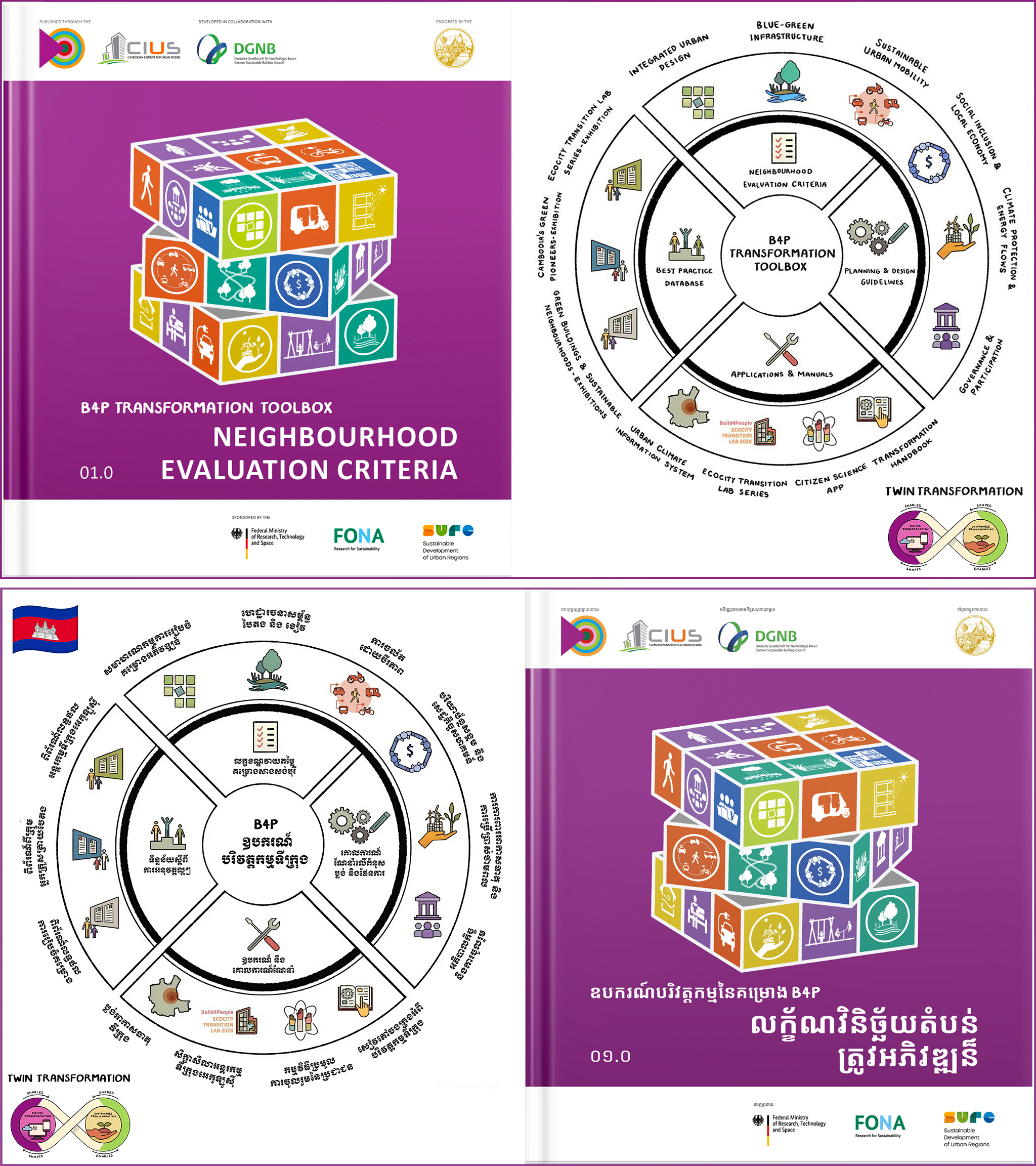
Build4People is very much thrilled to announce the publication of a key component of the B4P Transformation Toolbox, the Neighbourhood Evaluation Criteria, both in English and in Khmer language.
This is the first tool available in Cambodia 🇰🇭 to measure sustainability of urban neighborhoods. For example, its application enables state authorities to select the design proposal with the best sustainability performance.
In a country where urban development is overwhelmingly privatized, this is a major achievement. In this way, the Build4People Neighbourhood Evaluation Criteria contribute to transparency and reduce prevalent greenwashing.
The Build4People Neighbourhood Evaluation Criteria publication contains 24 criteria and about 100 indicators in total to enhance sustainability qualities for new neighbourhoods. These are summarized by means of 14 minimum sustainability indicators covering the whole portfolio of urban sustainability from integrated urban design, sustainable urban mobility, blue-green infrastructure, climate protection, local economic development, social inclusion and governance and participation.
Download link:
It is important to know that right now, the indicators and criteria are not set into stone but will undergo iterative context-sensitive testing.
Among others, we will facilitate the experimental implementation of the Build4People Neighbourhood Evaluation Criteria in March 2026 by means of an urban lab (the so-called B4P Transition Manufactory) together with Phnom Penh Capital Hall. Thereby, the main goal is to develop criteria-based design proposals illustrated by a dynamic 3D urban neighbourhood model. We will share more information on this exciting transformative approach in the weeks to come.
Build4People would like to express its deep gratitude to Eble Messerschmidt Partner, particularly to Rolf Messerschmidt, Oliver Lambrecht, Núria Roig and to DGNB, the German Sustainable Building Council, particularly to Dr. Stephan Anders, and to the Cambodian Institute for Urban Studies, particularly to Tep Makathy and Kul Socheata for their strong support to develop this meaningful product and also for their dedicated translation efforts.
The Cambodian Institute for Urban Studies is also a co-publisher of this guideline and major stakeholder of its local dissemination. Thanks also to Martin Aerne and to Michael Waibel for their thorough reviewing support.
#Build4People#BMFTR_SUREregions#sustainableneighbourhoods#sustainabilitycriteria