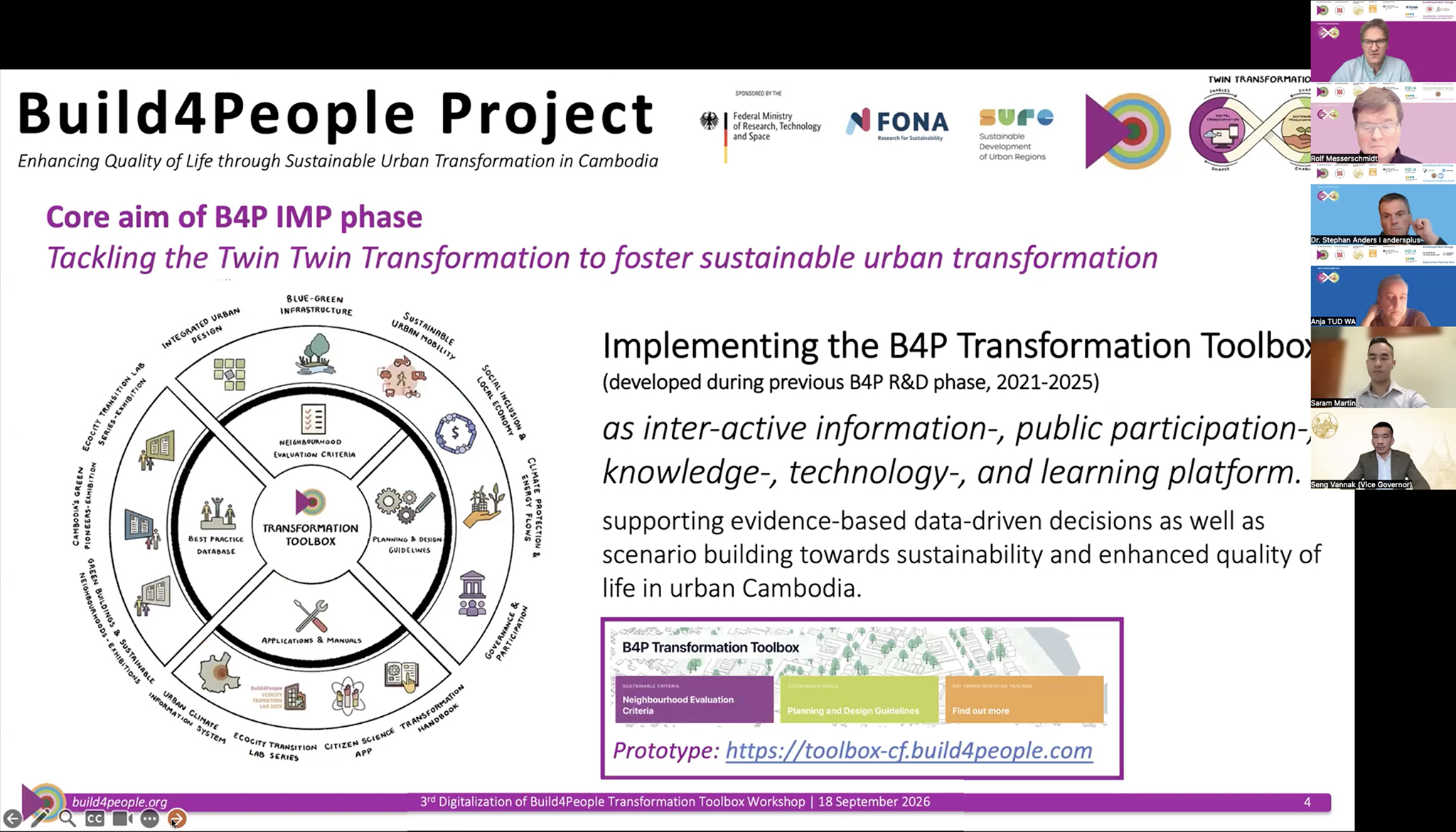
In the presence of H.E. Vannak Seng, Vice-Governor of Phnom Penh City, Build4People held an important strategic meeting with representatives of Phnom Penh Capital Hall (PPCH), focusing on the further implementation and digitalisation of the Build4People Transformation Toolbox.
At the heart of the discussion was the so-called Twin Transformation: combining digitalisation with sustainability to support evidence-based, data-driven decision-making and scenario building for a more sustainable urban future and an enhanced quality of life in Phnom Penh.
🔹 Neighbourhood Evaluation Criteria
A key component of the Transformation Toolbox is the newly developed Neighbourhood Evaluation Criteria, designed to support the assessment of sustainability performance at neighbourhood level. Build4People is currently working towards testing and integrating these criteria into Cambodian planning and implementation processes, including discussions with the Ministry of Land Management, Urban Planning and Construction.
🔹 Citizen Science for Public Participation
The Build4People Citizen Science App, currently operated by the Royal University of Phnom Penh (RUPP), is already being used as a scientific diagnostic tool. Its potential future use as a public participation tool for Phnom Penh, for example to assess citizens’ perceptions of urban green spaces, was another important topic of discussion.
🔹 From Research to Implementation
The upcoming Build4People Transition Manufactory #2, planned for early December 2026, will take a major step towards implementation by testing the B4P Neighbourhood Evaluation Criteria, which enable the measurement of neighbourhood sustainability performance in Cambodia for the first time. By combining real-world project testing with technical exchange with the Ministry, digitalisation activities and cooperation with Phnom Penh Capital Hall, the Build4People Transition Manufactory will help translate the criteria from research into practical planning and implementation.
The discussions demonstrate once again that sustainable urban transformation requires more than innovative research and technologies. It requires strong partnerships, institutional cooperation, locally adapted tools and, above all, a clear pathway from knowledge generation to practical implementation.
We are very much looking forward to continuing this joint endeavour with Phnom Penh Capital Hall, RUPP, MLMUPC and our many Cambodian and international partners (CIUS Cambodian Institute for Urban Studies Organization, Royal University of Phnom Penh) towards a more sustainable, inclusive and liveable Phnom Penh. 🌱🏙️🌱
Build4People
RESEARCH FOR BETTER QUALITY OF URBAN LIFE