
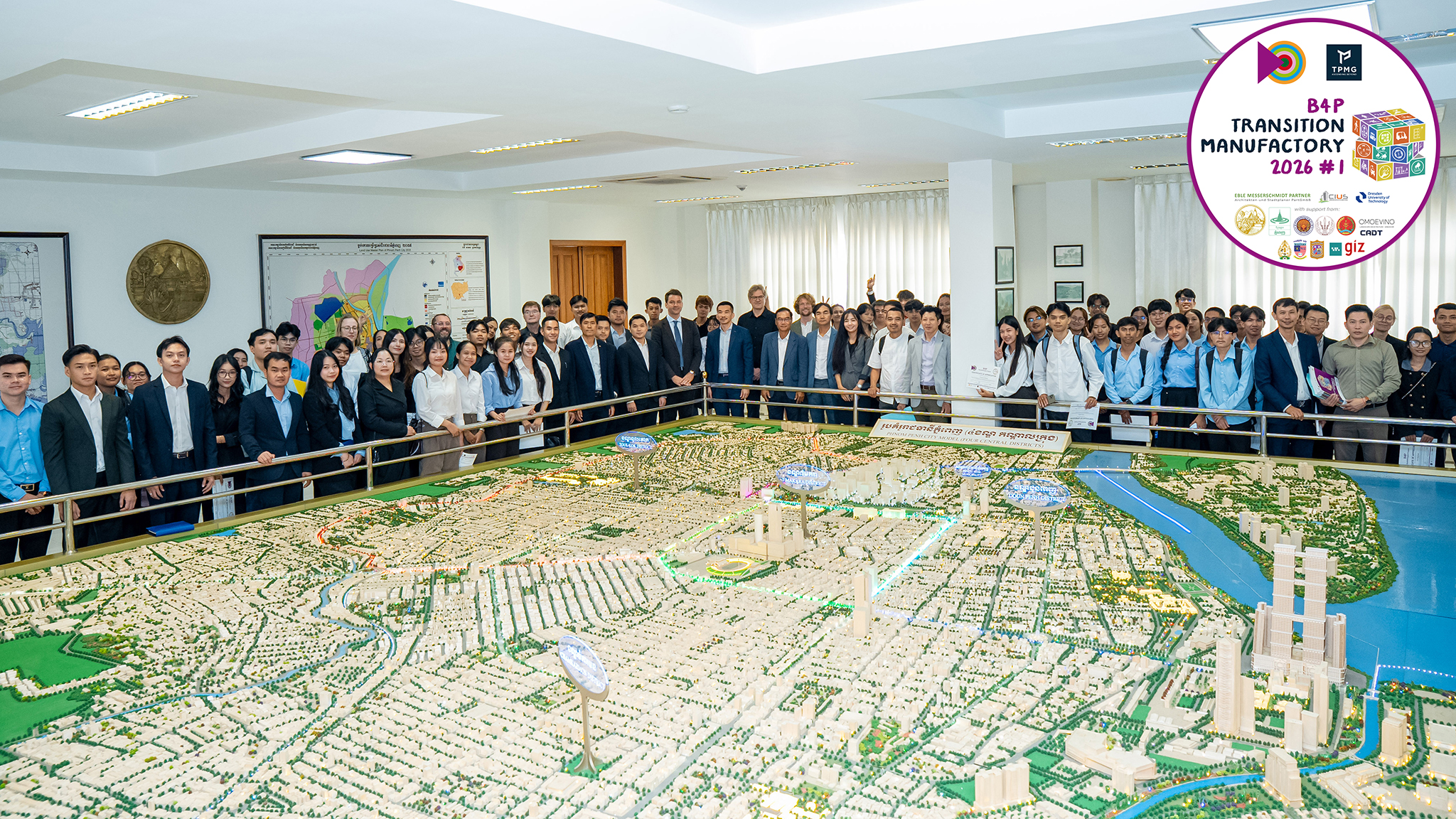
On 13 March 2023, the Presentation Conference of the B4P Transition Manufactory took place at Phnom Penh City Hall.

This event presented the comprehensive results of different working groups from a one week living lab to develop alternative visions of sustainable urban development in the case of the 200 ha development Mekong Quay Riverfront City developed by the Cambodian company TP Moral Group.

The biggest working group, involving experts and students from the Cambodian Institute of Urban Studies, Eble Messerschmidt Partner, TU Dresden, OMGEVING Ho Chi Minh City, Royal University of Fine Arts, Norton University, Western University, and Paññāsāstra University of Cambodia focused on the application of the B4P guidelines and evaluation criteria meant to consider the design and implementation of a blue-green infrastructure as an essential part of the new neighbourhood.

Based on an analysis of the existing landscape structure in the surrounding area and inspiration from a landscape urbanism project in Bordeaux-France, initial ideas have been developed.

The landscape strategy for the green infrastructure includes green and biodiversity fingers connecting the project area with the landscape structure, as well as passive and active green zones along the riverfront and a wetland park. The water strategy for the blue infrastructure takes stormwater coming from the surrounding areas of the local communities into consideration. A sponge city concept for the project provides stormwater infiltration within the blocks and swales in the green fingers for a controlled discharge to the Mekong River. The urban climate strategy focusses on climate adaptation and takes the prevailing local wind directions with ventilation corridors and bioclimatic parks into account.

Furthermore, the sustainable mobility concept based on transit-oriented development and an integrated urban design strategy with a mixed land use approach shall contribute a multi-layered and comprehensive master plan approach. A quick assessment of the B4P Evaluation Criteria with the internet tool showed the potential for high sustainability performance of an enhanced master plan with regard to integrated urban design, blue-green infrastructure and sustainable urban mobility.

Another working group deliberately selected another visioning approach apart from technical design and presented three short video clips of so-called “Visual Urban Utopias”, inspired by the works of the German artist Jan Kamensky, with the aim to raise awareness of the opportunities of a more inclusive and gender-sensitive urban development of Phnom Penh. This working group was led by Sokunlanita May, co-founder of the association W.A.E. – Women in Architecture and Engineering.

More on a meta level, a working group led by Niklas Kossow from CityLAB Berlin in cooperation with representatives and students from CADT, the Cambodian Academy of Digital Technology supported by German GIZ, discussed Build4People’s Twin Transformation approach and the role of digitalisation and AI in urban development. In the case of Build4People’s Implementation phase, digital transformation and sustainable urban transformation influence each other. First, it helps us understand the city through data analysis and simulation. Second, it helps to involve people, for example through the B4P Citizen Science APP that collects survey data from local residents. Third, it helps us to imagine urban futures through digital planning tools and AI-based visualisations. And finally, it inspires ideas for digital tools that could make urban life more sustainable and inclusive. And at the same time, the project’s people-centred sustainability criteria shape what kind of digitalisation is relevant and useful. So digitalisation is not an end in itself — it is directed toward better urban quality of life.

An example of a specific application of people’s involvement was presented by a working group led by Bunleng Se from Royal University of Phnom Penh. He showed that by the combination of objective data and of subjective data, the latter measured by means of the RUPP-B4P Thermal Comfort App, a detailed analysis of the local micro climate can be done, the results of which can be generalized in the case of the new neighbourhood development of Mekong Quay Riverfront City.

After the presentation of the four working groups, a Letter of Intent was exchanged between the Build4People representative and the CEO of TP Moral Group.

This was followed by an exchange of the B4P Neighbourhood Evaluation Criteria publication as well as of the B4P Planning and Design guidelines, all in Khmer language, to leading representatives of TP Moral Group and of Phnom Penh Capital Hall.

Furthermore, the participating students received official Certificates of Appreciation to honour their dedicated and engaged work.

Closing words were held by H.E. Vannak Seng, Vice-Governor of Phnom Penh, and by Christof Weigelmeier, Vice-Head of Mission of the German Embassy.

The whole Build4People team would like to express its deep gratitude to all participants of this exciting and inspiring collective endeavour.
The outputs shown during the B4P TM Presentation Conference will get further refined in the course of the next months until the 2nd B4P Transition Manufactury, due to November / December 2026.